International rankings: why are French students falling so far behind in mathematics?
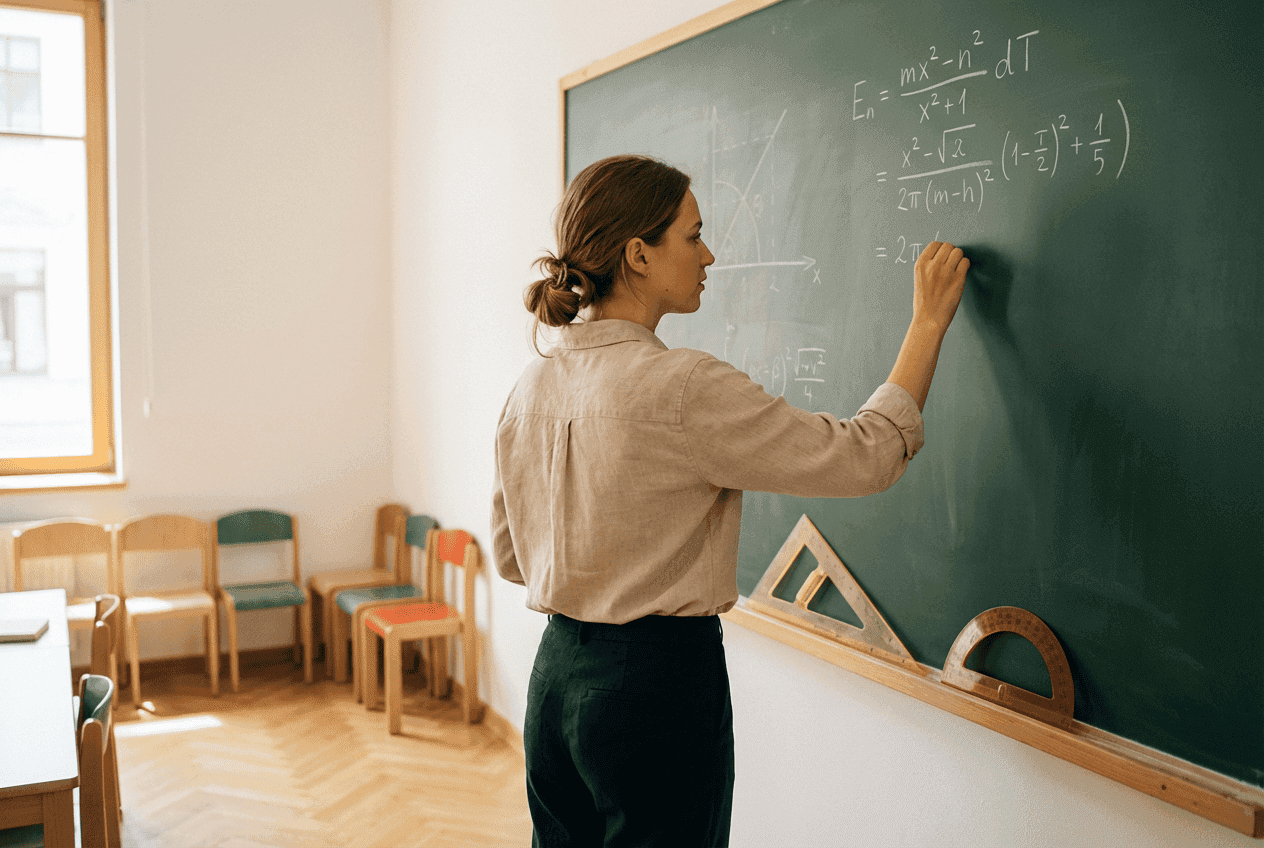
With every publication of the results of major international surveys such as PISA (Programme for International Student Assessment) or TIMSS (Trends in International Mathematics and Science Study), the finding hits like an electric shock: France is falling behind. Long renowned for the excellence of its mathematical community and its numerous Fields medalists, our country is seeing the general level of its students erode year after year.
However, this decline is not inevitable. To understand how to reverse the trend, it is essential to analyze the evolution of this level, to identify the causes from an early age, and to draw inspiration from teaching methods that work.
A historic decline in math standards
The downgrading of French students is not just an impression, but is supported by rigorous statistical data that measures both an absolute decline and a relative decline in our performance.
An absolute decline over the last 30 years
If we compare French students today to those of 10, 20 or 30 years ago, the drop is dizzying. Studies conducted by DEPP (The evolution of calculation skills in CM2 (5th grade) students at a thirty-year interval) show, for example, that a CM2 pupil today has, on average, the standard of a CE2 (3rd grade) pupil at the end of the 1980s. Mastery of basic operations (addition, subtraction, multiplication, division) and simple problem solving have fallen steadily. Raw scores in national assessments show a real loss of landmarks on achievements that once seemed elementary.
A relative downgrading compared to other countries
On the international stage, this decline has resulted in a plunge down the rankings. The PISA survey, which assesses 15-year-olds, now places France below the OECD average in mathematics, with a loss of 11 positions in 15 years. But it is above all the TIMSS study that sounds the alarm: during the latest editions, France ranked among the last European countries in mathematics, with scores far below those of the best Russian or Asian students.
Primary school: the heart of the problem
While media attention often focuses on middle or high school, the problem takes root much earlier. All studies show that the foundations of logical-mathematical reasoning are built in primary school.
A slump that affects every student
Contrary to certain received ideas, the drop in primary level does not only affect students from disadvantaged backgrounds or schools in priority education networks. Data from the TIMSS study (which assesses CM1/4th grade students) are final: the drop in performance is systemic.
It affects:
• All social backgrounds: Even children from the most advantaged socio-professional categories (CSP+) show declining scores and fall below the European average for their category. French students from the most advantaged backgrounds thus have scores lower than Japanese or Singaporean schoolchildren from the least advantaged backgrounds. Nationally, a report by the High Commission for Strategy and Planning estimates that in 2017, a child of executives in CM2 obtained calculation results lower than those obtained in 1987 by a child of a worker or employee.
• Both genders: Boys and girls are affected in an almost identical way by this slump, although we have one of the highest gender gaps in performance in the world.
• All types of schooling: Both public and private education show the same decline.
This worrying observation must lead us to a deep self-questioning: no, French children have not become "hopeless" in mathematics, the issue lies in our educational system.
Why are our children struggling with mathematics?
To offer effective solutions, we must first make a lucid diagnosis of the causes intrinsic to France, while looking at what makes our neighbors successful.
The flaws of the French education system
Several factors explain the current situation in our primary schools:
• The reduction of time devoted to math: With successive reforms, the weekly hours dedicated to the subject have shrunk. In 30 years, students have lost about 1h30 of mathematical instruction per week.
• Primary school teacher training: In France, nearly 80% of primary school teachers come from humanities or social science backgrounds. Many of them admit to a lack of confidence, or even a real apprehension towards mathematics, which affects the way they teach.
• Unstable and sometimes abstract programs: Frequent changes in curricula and methods contribute to weakening primary school teachers, who are sometimes insufficiently trained.
• A lack of resources: While mathematics suffers particularly, the decline in level is generalized and emphasized by the entire teaching body, penalized by a lack of resources impacting the quality of teaching (overcrowded and heterogeneous classes, lack of equipment, shortage of digital tools...).
The decline in the level of French students is therefore not inexorable. A thorough review of the French education system, both public and private, must be carried out in order to re-establish the country's youth at the forefront.
The model of successful countries: Singapore and the United Kingdom
Faced with these difficulties, other nations have been able to reform. The Singapore method, consistently at the top of the TIMSS and PISA rankings, is based on an extremely gradual approach: from the concrete (manipulation of objects), to the pictorial (graphical representation), and finally to the abstract (numbers and symbols).
Closer to home, the United Kingdom has made a spectacular U-turn. Concerned about their own results a decade ago, the British invested heavily in Maths Hubs (regional centers of excellence), imported the Singapore method, and redesigned continuing education for their teachers. Today, the level of their young students has made a spectacular leap forward, proving that a rapid recovery is possible.
Reversing the trend: excellence is within reach
While the international assessment is severe, it should in no way discourage us. Mathematics is not a gift reserved for an elite; it can be learned, understood, and mastered.
Restoring confidence and building a love for math
The first step in helping a child progress and move past mental blocks is to relieve their anxiety. The fear of making mistakes is one of the greatest barriers to learning. It is crucial to demystify the subject and value reasoning as much as the final result. A child who has self-confidence, and is allowed to make mistakes to learn better, eventually develops a genuine interest in the intellectual game that mathematics represents.
The Mathéo approach: a springboard to success
It is with this deep conviction that the Mathéo approach was designed. Aware of the limits of the traditional system, we have developed a method that draws inspiration from global best practices and adapts them to the needs of every child.
Our mission is clear: combining high standards with empathy. With Mathéo, learning mathematics makes sense again. We emphasize:
• Clarity of concepts: Using strong visual representations before moving on to rigorous abstraction.
• Personalization: Because each child moves at their own pace, our support identifies specific gaps to fill them in a targeted manner, without ever stigmatizing.
• The joy of learning: By making mathematics interactive and stimulating, we transform a frequently dreaded subject into an exciting tool for thought.
The French decline is not irreversible. With the right methods, adapted teaching tools, and quality guidance, every child has the potential not only to catch up, but above all to excel and rediscover a taste for mathematics. At Mathéo, we are proud to build, together with you, tomorrow's success.
.
Ready to restore your child's confidence in mathematics? Discover the Mathéo method now and give them the keys to success.