Singapore math: why it changes everything in elementary school mathematics
For 20 years, Singaporean students have held the top spots in international mathematics rankings. Meanwhile, France is falling behind. The link between the two? A teaching method radically different from what our children experience every day in the classroom.
What the numbers say
The results of the TIMSS 2023 study are undeniable. At the end of CM1 (4th grade), only 3% of French schoolchildren reach an advanced level in mathematics, compared to an average of 9% in Europe and 41% in Singapore. Even more concerning: 42% of French students are deemed to have a fragile mastery at the end of CM2 (5th grade).
We can debate the causes for a long time (teacher training, time dedicated to math, allocated resources), but one fact remains: the countries that achieve the best results all use pedagogical approaches that share common principles. And the Singapore method is the most documented model.
The 3 principles that make the difference
From concrete to abstract: the CPA progression
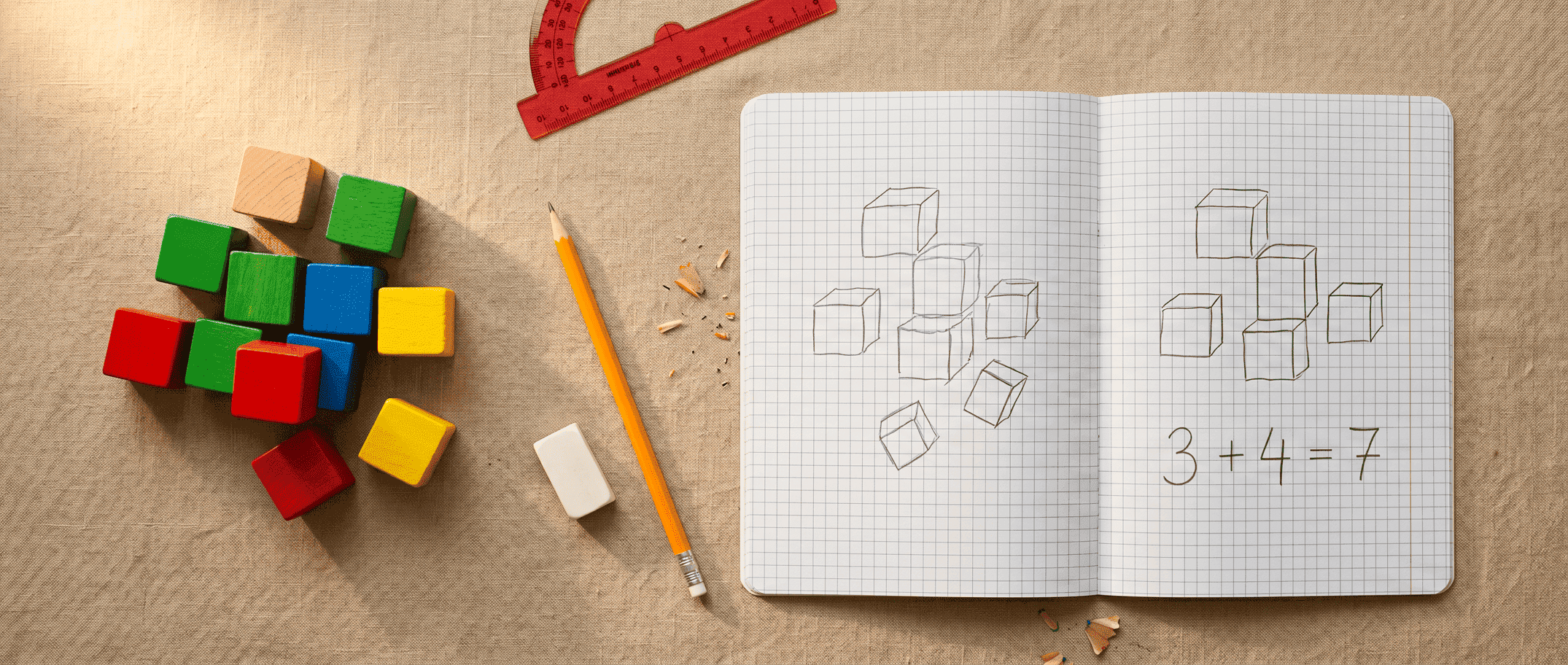
The Singapore method relies on a three-step progression called CPA: Concrete, Pictorial (« Visual »), Abstract.
The child begins by manipulating real objects (cubes, counters, bars). They then move on to visual representations (drawings, diagrams, modeling bars). Only after that do they approach abstract mathematical writing.
In France, we often do the opposite: we give the abstract rule first, then we ask the child to apply it. For a 7-year-old child who has no mental image of what "3/4" represents, it is like learning a language without ever hearing anyone speak it.
Mastery before speed
In Singapore, students do not move on to the next chapter until the previous one is understood. In France, the program moves forward regardless of the students' level of understanding. The result: gaps that accumulate and become impossible to bridge in middle school.
The Singapore method dedicates much more time to each concept. Fewer topics are covered, but each is mastered in depth. A child who truly understands fractions in CE2 (3rd grade) will then have no trouble with percentages.
Mental math as a foundation
The first 5 to 10 minutes of each session in Singapore are dedicated to mental math. Not as an incidental exercise, but as the foundation of everything else.
A child who instantly knows that 7 × 8 = 56 can focus on solving a complex problem. A child who still has to count on their fingers wastes all their cognitive energy on the calculation itself and has none left to think.
Why France does not adopt this method
The question regularly returns to the French educational debate, especially since the 2018 Villani report, which explicitly recommended drawing inspiration from the Singapore method.
The problem is not that the method is scientifically contested. The results are documented in dozens of countries. The problem is structural: training 300,000 schoolteachers in a new pedagogical approach takes time, money, and continuous political will.
In the meantime, some private institutions and specialized structures have started to apply it. The feedback is consistent: children who learn with this method develop a deeper understanding, more self-confidence, and better results.
What parents can do right now
A few principles of the Singapore method can be applied at home:
When your child learns a new concept, always start with the concrete. For fractions, cut a pizza into slices. For multiplication, make groups of objects. The transition to the abstract will come naturally.
Prioritize understanding over speed. "Do you understand why?" matters more than "Did you get the right answer?". A child who understands the mechanism will always find the result. A child who has learned by heart will be stuck at the first exercise that is different.
Make mental math a daily ritual. 5 minutes a day, in the form of a game, in the car, or at the dinner table. Progress comes quickly and is visible.
The Mathéo approach: Singapore adapted to the French context
At Mathéo, the Singapore method is not applied as is. It is adapted to the French curriculum and enriched on several points: algebra is introduced as early as CP/1st grade (as in Russia and South Korea), mental math opens every session, and adaptive learning tools allow exercises to be personalized according to each child's actual level.
Small group classes (maximum of 8 students) allow the teacher to follow each student's progress and ensure that no concept is glossed over. The monthly individual tutoring lesson completes the system to target the specific needs of each student.
Would you like to know more about our approach? Contact us to discuss your child's level and discover how Mathéo can support them.