Teaching: what makes Russian mathematics revolutionary
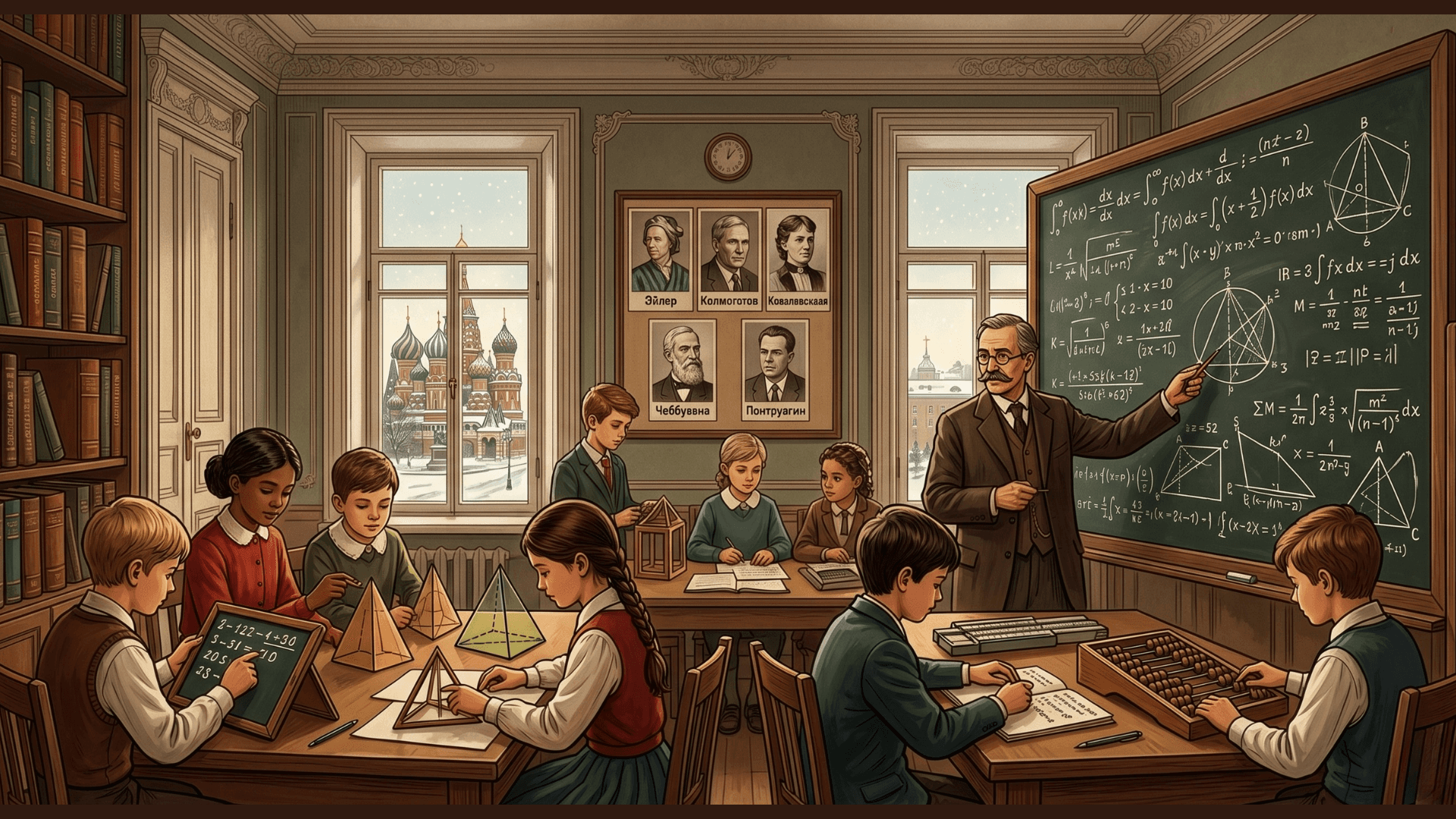
The Singapore method often comes up when people talk about alternatives to the way math is taught in France. Much less is said about what is done in Russia, yet some of the most solid work on how children learn math comes from there. At Mathéo, we drew on it. Here's why.
The Russian school: a tradition little known in France
It all began in the 1920s in Moscow. A group of psychologists decided to study a simple question: how does thinking develop in children? Their answer went against what people believed at the time.
For them, thinking does not develop spontaneously with age. It is built through activity, that is, through what children do, handle, explore and put into words. Children don't truly understand by listening to an explanation. They understand by acting on objects, then gradually internalizing that action.
This is what Alexei Leontiev formalized as activity theory. Applied to math, it has a direct implication: learning to divide is not memorizing a rule. It starts with physically sharing objects, observing what happens, building a mental image of the operation, and only then coding it all in numbers. The symbol comes last, never first.
Vygotsky and the zone of proximal development
Lev Vygotsky, a central figure of this school, introduced a concept that profoundly changes how we think about the teacher's role: the zone of proximal development.
The idea is simple. Between what a child can do alone and what they cannot do at all yet, there is an in-between space: what they can do with the help of an adult or a more advanced peer. It is in this space, and only there, that learning is productive.
Below it, the child reviews what they already know. Beyond it, they are lost. Inside the zone, they make progress.
For a teacher, this means one concrete thing: their role is not to simplify until everything becomes obvious. It is to set the difficulty just above what the student can do alone, and to stay close while they work it out.
Davydov: doing algebra before counting
This is probably the most counterintuitive idea in the whole tradition. Vasily Davydov, a mathematician and psychologist, designed a complete elementary math curriculum starting in 1959. His starting point: what if we began with algebra rather than arithmetic?
His reasoning goes like this. Arithmetic taught too early locks children into overly empirical thinking. They reason about particular cases and concrete values. Algebra, introduced at the right time, gives them access to something more powerful: the ability to reason about general structures, regardless of the values.
In practice, in Davydov's curriculum, 1st graders handle paper strips and weights before they can count beyond a few numbers. They discover that two lengths placed end to end make a third. That this can be written A + B = C. That this relationship works both ways: if you know the whole and one part, you can find the other. They build the fundamental properties — commutativity, associativity — on physical objects, without ever naming them.
Numbers come afterwards, as special cases of a structure they already understand. This reversal was tested for more than thirty years at School No. 91 in Moscow. By the end of elementary school, students taught with this curriculum could solve algebra problems that regular students only meet in high school (Schmittau and Morris, 2004).
What it changes in the classroom
Russian teaching is not just theory. It produces very specific classroom practices that stand in contrast to French habits.
Thinking out loud is systematic. Students don't apply a procedure in silence: they explain what they are doing, why they are doing it and what they are looking for. For Galperin, another major figure of this school, this often-neglected step is a necessary condition for internalization. A child who can do something but can't explain it hasn't really understood. They have learned a gesture.
Rigorous notation is another hallmark. Neat notebooks, aligned digits, precise geometric constructions. This isn't formality for its own sake. It reflects the idea that thinking laid out clearly on paper is thinking that is well built in the head.
Hard problems come early. Where French schools carefully increase the difficulty so as not to set students up for failure, Russian teaching presents structurally demanding obstacles from the very first years. Not to discourage — but because it is by tackling a real problem that you build real tools for thinking.
Mathematical dialogue, finally. The teacher asks an open question. Several students suggest different answers. They are compared, disagreements are identified, and the proof is built together. Thinking takes shape through discussion, not passive listening.
What the "Measure Up" program proved
The question always asked about these approaches: do they really work outside the ideal conditions of an experimental school in Moscow?
The answer is yes. The "Measure Up" program, developed in Hawaii and directly inspired by Davydov's curriculum, was evaluated with 129 students in 5th and 6th grade. Children who followed the program developed markedly better logical reasoning and command of algebra than the control group (Slovin and Venenciano, 2008).
These results are not isolated. Replications have been carried out in Canada, Italy, Sweden and Brazil, with consistent conclusions.
What Mathéo takes from it
At Mathéo, we draw three lessons from Davydov's curriculum.
The first: children can tackle hard problems early, as long as they are guided. We don't simplify to avoid discomfort. We calibrate, and we support.
The second: we always ask students to put things into words. When a student solves a problem in silence, we ask them to explain it. Not to check, but to consolidate. Speaking is a step in learning, not just a reflection of it.
The third: we focus on structures before values. Understanding why a + b = b + a with paper strips at age 7 means never having to "learn" commutativity in 7th grade. It's already there, built in their head, long before.
Would you like to know more about our approach? Contact us to discuss your child's level and find out how Mathéo can support them.